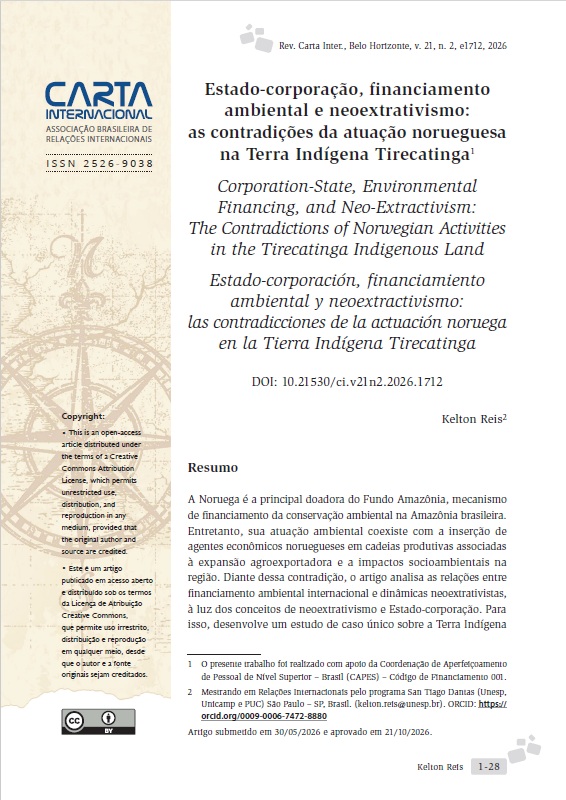
Corporation-State, Environmental Financing, and Neo-Extractivism
The Contradictions of Norwegian Activities in the Tirecatinga Indigenous Land
DOI:
https://doi.org/10.21530/ci.v21n2.2026.1712Keywords:
Norway, Political Ecology, State-corporation, Tirecatinga Indigenous Territory, Neo-extractivismAbstract
Norway is the main donor to the Amazon Fund, a financing mechanism for environmental
conservation in the Brazilian Amazon. However, its environmental engagement coexists
with the involvement of Norwegian economic actors in production chains associated with
agricultural frontier expansion and socio-environmental impacts in the region. Against
this backdrop, the article examines the relationship between international environmental
financing and neo-extractivist dynamics through the concepts of neo-extractivism and the
corporate-state. It develops a single-case study of the Tirecatinga Indigenous Land, located in
Sapezal, Mato Grosso, based on documentary analysis and secondary data on environmental
financing, international trade, agricultural production, and socio-environmental impacts.
The findings reveal connections between environmental governance mechanisms, agroexport
economic circuits, and pressures on Indigenous territories, highlighting the limits
of environmental conservation when embedded in economic structures that reproduce
dynamics of nature exploitation.
Downloads
Published
How to Cite
Issue
Section
License
Copyright (c) 2026 Kelton Allan Kaiser Baraldi dos Reis

This work is licensed under a Creative Commons Attribution 4.0 International License.
Authors who publish with this journal agree to the following terms:
- Authors retain copyright and grant the journal right of first publication with the work simultaneously licensed under a Creative Commons Atribuição 4.0 Internacional that allows others to share the work with an acknowledgement of the work's authorship and initial publication in this journal.
- Authors are able to enter into separate, additional contractual arrangements for the non-exclusive distribution of the journal's published version of the work (post it to an institutional repository or publish it in a book, for example), with an acknowledgement of its initial publication in this journal.